
Digital piracy in the publishing sector continues to pose a significant threat to the entire supply chain: authors, publishers, booksellers and readers. In recent years, although enforcement actions have intensified, the phenomenon has evolved, becoming even more widespread and technologically sophisticated.
According to the latest update of the IPSOS research for AIE (the Italian Publishers Association), published in March 2024, in the previous year piracy cost Italian book publishing around €705 million in lost revenue, up from the 528 million estimated in 2020. This corresponds to 24% of the overall market, excluding the school sector and exports.
At the systemic level, the damage to the country as a whole is close to 705 million euros, with an estimated tax loss for the State of more than 298 million euros. In addition, it is estimated to cause lost employment equivalent to 4,900 jobs in the supply chain and around 12,000 in related industries.
Overall, however, the trend is downward, with acts of piracy in 2023 falling by 8% compared with 2021, bringing losses down from €771 million to €705 million.
According to the same survey, in 2023, 34% of Italians over the age of 15 said they had read at least one pirated book in the previous 12 months, with peaks of 58% in the 25 to 39 age group.
Not just Telegram
Telegram continues to be one of the main platforms through which copyrighted works circulate. Thanks to its ease of access and the ability to create encrypted channels, pirates manage to distribute entire publishing series for free, from public-competition exam textbooks to major fiction and non-fiction bestsellers.
However, pirated content today also travels via:
- Public cloud services (Google Drive, Dropbox, Mega): file-hosting links are shared on forums, social networks, blogs and even in comments on platforms such as TikTok and Instagram.
- Social networks: Facebook groups, posts on X (formerly Twitter) and even Discord channels are now established tools for spreading illicit material.
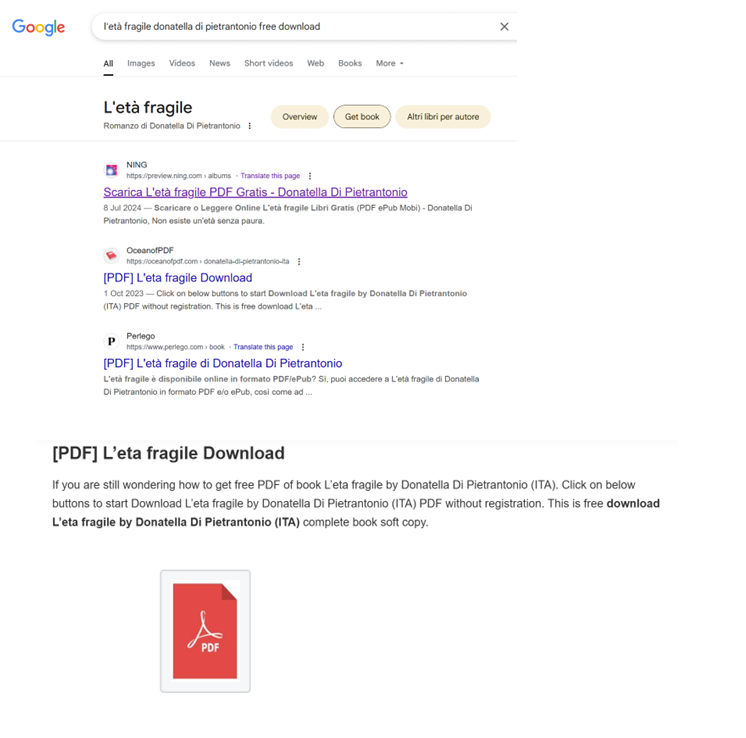
- Search engines: despite improved algorithms, it is still relatively easy to find sites that illegally offer e-books, often disguised as “educational” or “review” platforms.
- Dedicated unofficial apps: pirate apps have emerged – often outside the official stores – that aggregate e-books and make them available by subscription or for free, sometimes even via streaming.
Below are some examples relating to “L’età fragile” by Donatella Di Pietrantonio, winner of the 2024 Premio Strega.
Peer-to-peer technologies
Even the old peer-to-peer technologies, although considered obsolete and certainly used less by the average user than in the mid-2000s, continue to survive in the underbelly of digital piracy. In 2023 a new version of eMule (v0.60) was released, with security updates (including HTTPS support and a better system for correcting corrupted files) and a new procedure for recovering damaged files, sparking renewed interest in some user niches.
Link sharing has moved to private, closed forums, Telegram channels and dark web communities. But it remains an active method, even if less accessible to less experienced users.
The role of the deep and dark web
Finally, a share of the illegal circulation of content passes through the so-called deep web, and in some cases through the dark web. Here one finds illicit forums and marketplaces where all kinds of illegal products can be bought, so that it is not only pirated e-books that circulate: entire digital libraries are sold on hard drives, as is access to cloud repositories containing thousands of academic and professional titles.
How to take action
Intellectual property rights holders can act in several ways to counter piracy in the publishing sector. The first is certainly to contact the authorities (mainly the Postal Police or the Guardia di Finanza) or to hope for proactive action on their part.
Another option is to seek support from a company able to effectively identify illicit content, monitor the appearance of any new illegal content and remove it through reports to internet service providers. For more information on the above procedures, you can send us a message through our contact form or write to us by email at protection@argobs.com.